
Richard Paul Lohse
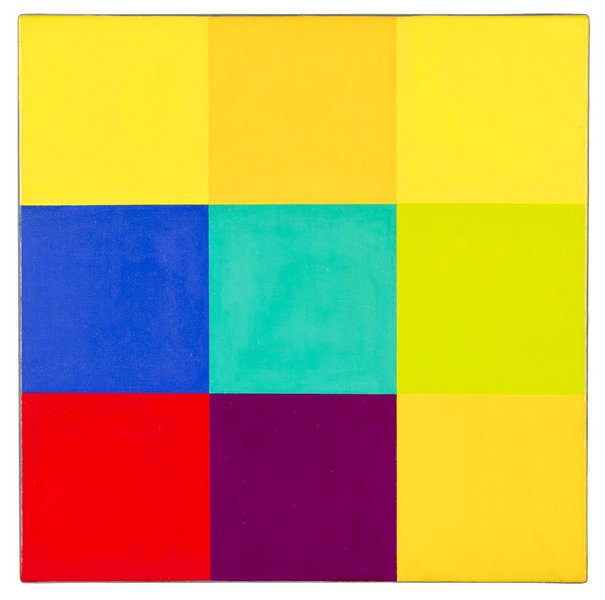
Drei komplementäre Diagonalordnungen mit gelben Ecken – Variation C, 1978
[Three Complementary Diagonal Arrangements with Yellow Corners – Variation C]
Acrylic on canvas
© VG Bild-Kunst, Bonn 2022
Photo: Gerhard Sauer
This work, created in 1978 by the Swiss painter, graphic artist and theorist Richard Paul Lohse, lives from its vibrant colour contrasts. Lohse numbered, alongside Max Bill, Camille Graeser and Verena Loewensberg, among the chief representatives of the Zurich Concretists, and produced an œuvre inspired by Russian Constructivism and the Dutch De Stijl group that distinguished itself by its systematic and analytic approach.
In the painting shown here, nine coloured squares that have been placed evenly on a likewise square surface, together with the title of the piece Drei komplementäre Diagonalordnungen mit gelben Ecken –Variation C [Three Complementary Diagonal Arrangements with Yellow Corners – Variation C] prompt the viewer to work out how the composition was constructed. Ultimately this can also be divined from the three pairs of colours, red and turquoise, blue and yellowish orange, and violet and yellowish green, which each meet along a diagonal. The painting belongs to the series Modulare und Serielle Ordnungen [Modular and Serial Systems] that Lohse commenced in 1943. The basic element in these compositions is the square, which as a modular form is used to articulate the picture surface. The result is a regular grid structure that is set out parallel to the shape of the picture carrier. This method of creating an image is thus based on producing a consonance in the artistic means, and was the result of experiments in which Lohse attempted to resolve the distinction between the structure of the image and the image carrier.
Taking the square as his building block, he was able to form non-hierarchical, serial arrangements that can be varied or extended to the same degree, and with that make the picture part of a larger system. The idea of standardising the individual form was augmented by the immaculate paint finish he employed, which shows not an irregularity nor even a brush stroke. Yet in order to ensure the individuality of every coloured square, Lohse kept identically-coloured squares separate from one another in his Modular and Serial Systems by always bordering them with other tones. Nevertheless, neighbouring squares with similar colours may initially present a summary impression of a single colour, as is the case for instance with the yellow fields in the present composition. (Jutta Fischer)
Richard Paul Lohse
1902 born in Zurich
1988 died in Zurich